
Author: patron
Feast of Christ the KingFeast of Christ the King
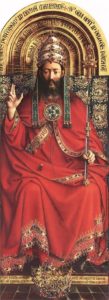
The Solemnity of Our Lord Jesus Christ, King of the Universe, commonly referred to as the Feast of Christ the King or Christ the King Sunday, is a relatively recent addition to the Western liturgical calendar, having been instituted in 1925 by Pope Pius XI for the Roman Rite of the Catholic Church. In 1970 its Roman Rite observance was moved to the final Sunday of Ordinary Time. Therefore, the earliest date on which it can occur is 20 November and the latest is 26 November. The Anglican, Lutheran, and many other Protestant churches also celebrate the Feast of Christ the King, which is contained in the Revised Common Lectionary. Roman Catholics adhering to the Extraordinary Form of the Roman Rite use the General Roman Calendar of 1960, and as such continue to observe the Solemnity on its original date of the final Sunday of October. It is also observed on the same computed date as the final Sunday of the ecclesiastical year, the Sunday before the First Sunday of Advent, by Western rite parishes of the Russian Orthodox Church Outside Russia.
Clement of AlexandriaClement of Alexandria

Titus Flavius Clemens, also known as Clement of Alexandria or Saint Clement (Greek: Κλήμης ὁ Ἀλεξανδρεύς; c. 150 – c. 215 AD),[5] was a Christian theologian and philosopher who taught at the Catechetical School of Alexandria. Among his pupils were Origen and Alexander of Jerusalem. A convert to Christianity, he was an educated man who was familiar with classical Greek philosophy and literature. As his three major works demonstrate, Clement was influenced by Hellenistic philosophy to a greater extent than any other Christian thinker of his time, and in particular, by Plato and the Stoics. His secret works, which exist only in fragments, suggest that he was familiar with pre-Christian Jewish esotericism and Gnosticism as well. In one of his works he argued that Greek philosophy had its origin among non-Greeks, claiming that both Plato and Pythagoras were taught by Egyptian scholars.
Clement is usually regarded as a Church Father. He is venerated as a saint in Coptic Christianity, Eastern Catholicism, Ethiopian Christianity, and Anglicanism. He was revered in Western Catholicism until 1586, when his name was removed from the Roman Martyrology by Pope Sixtus V on the advice of Baronius. The Eastern Orthodox Church officially stopped any veneration of Clement of Alexandria in the 10th century.
Saint Margaret of ScotlandSaint Margaret of Scotland
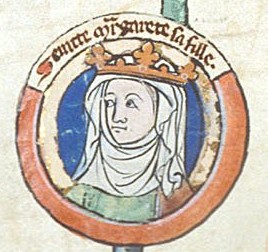
Saint Margaret of Scotland (Scottish Gaelic: Naomh Maighréad; Scots: Saunt Marget, c. 1045 – 16 November 1093), also known as Margaret of Wessex, was an English princess and a Scottish queen. Margaret was sometimes called “The Pearl of Scotland”. Born in the Kingdom of Hungary to the expatriate English prince Edward the Exile, Margaret and her family returned to England in 1057. Following the death of Harold Godwinson at the Battle of Hastings in 1066, her brother Edgar Ætheling was elected as King of England but never crowned. After she and her family fled north, Margaret married Malcolm III of Scotland by the end of 1070.
Margaret was a very pious Christian, and among many charitable works she established a ferry across the Firth of Forth in Scotland for pilgrims travelling to St Andrews in Fife, which gave the towns of South Queensferry and North Queensferry their names. Margaret was the mother of three kings of Scotland, or four, if Edmund of Scotland (who ruled with his uncle, Donald III) is counted, and of Matilda of Scotland, queen consort of England. According to the Vita S. Margaritae (Scotorum) Reginae (Life of St. Margaret, Queen (of the Scots)), attributed to Turgot of Durham, Margaret died at Edinburgh Castle in Edinburgh, Scotland in 1093, merely days after receiving the news of her husband and son’s deaths in battle.
In 1250, Pope Innocent IV canonised her, and her remains were reinterred in a shrine in Dunfermline Abbey in Fife, Scotland. Her relics were dispersed after the Scottish Reformation and subsequently lost. Mary, Queen of Scots, at one time owned her head, which was subsequently preserved by Jesuits in the Scots College, Douai, France, from where it was lost during the French Revolution.