In the Christian liturgical calendar, there are several different Feasts of the Cross, all of which commemorate the cross used in the crucifixion of Jesus. While Good Friday is dedicated to the Passion of Christ and the Crucifixion, these days celebrate the cross itself, as the instrument of salvation.
In English, it is called The Exaltation of the Holy Cross in the official translation of the Roman Missal, while the 1973 translation called it The Triumph of the Cross. In some parts of the Anglican Communion the feast is called Holy Cross Day, a name also used by Lutherans. The celebration is also sometimes called Holy Rood Day.
As per some Christian tradition the True Cross was discovered in 326 by Saint Helena, the mother of the Roman Emperor Constantine the Great, during a pilgrimage she made to Jerusalem. The Church of the Holy Sepulchre was then built at the site of the discovery, by order of Helena and Constantine. The church was dedicated nine years later, with a portion of the cross. One-third remained in Jerusalem, one-third was brought to Rome and deposited in the Sessorian basilica Santa Croce in Gerusalemme (Holy Cross in Jerusalem), and one-third was taken to Constantinople to make the city impregnable.
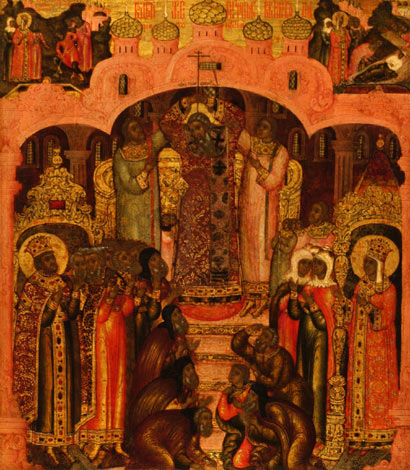
The date of the feast marks the dedication of the Church of the Holy Sepulchre in 335. This was a two-day festival: although the actual consecration of the church was on September 13, the cross itself was brought outside the church on September 14 so that the clergy and faithful could pray before the True Cross, and all could come forward to venerate it.
Red is the usual liturgical color in churches that follow such traditions. In Western Christianity, red vestments are worn at church services conducted on this day as well as Pentecost and other times of celebration. In the Roman Catholic liturgical observance, the red is worn only on this day, and if the day falls on a Sunday, its Mass readings[note 1] are used instead of those for the occurring Sunday in Ordinary Time. The lectionaries of the Church of England (and other Anglican churches) and Western Rite Orthodoxy also stipulate red as the liturgical color for ‘Holy Cross Day.’
In Eastern-Rite Orthodox Churches that use various liturgical colors, red vestments are also worn. Yet in these Orthodox churches, the wearing of red continues for a week after the feast.
In Western Rite Orthodox Parishes, the Wednesday, Friday, and Saturday of the calendar week after the one in which the feast day occurs, are designated as one of each year’s four sets of Ember days. In new calendar Western Rite Orthodox Parishes (e.g. those under the Antiochian Diocese) these ember days are the week following 14 September. In old calendar Western Rite Orthodox Parishes (e.g. those under the Russian Diocese) these ember days are the week following 27 September.
Until 1969, these ember days were a part of the liturgical calendar of the Roman Catholic Church. Organization of these celebrations in the ordinary form is now left to the decision of episcopal conferences in view of local conditions and customs. The ember days are still observed in the calendar of the Roman Rite’s “extraordinary form” and in the Anglican Ordinariate calendar.
September 14 is the titular feast of the Congregation of Holy Cross, The Companions of the Cross and the Episcopal Church’s Order of the Holy Cross. This date also marked the beginning of the period of fasting, except on Sundays and ending on Easter Sunday, that was stipulated for Carmelites in the Carmelite Rule of St. Albert of 1247. The Rule of St. Benedict also prescribes this day as the beginning of monastic winter (i.e., the period when there are three nocturns of psalms and readings at matins) which also ends at Easter.