Author: patron

Catherine of AlexandriaCatherine of Alexandria

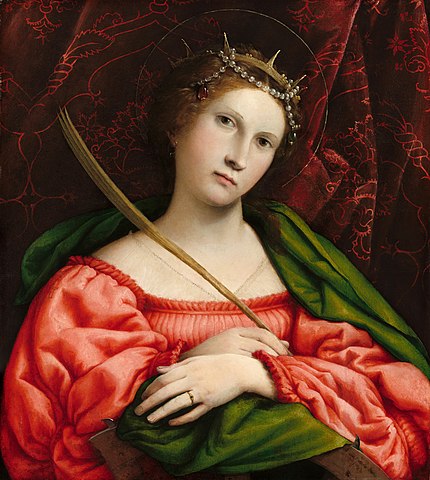
Saint Catherine, 1522

Catherine of Alexandria, or Katherine of Alexandria, also known as Saint Catherine of Alexandria, Saint Catherine of the Wheel and The Great Martyr Saint Catherine (Coptic: Ϯⲁⲅⲓⲁ Ⲕⲁⲧⲧⲣⲓⲛ; Greek: ἡ Ἁγία Αἰκατερίνη ἡ Μεγαλομάρτυς “Holy Catherine the Great Martyr”; Arabic: سانت كاترين‎; Latin: Catharina Alexandrina), is, according to tradition, a Christian saint and virgin, who was martyred in the early 4th century at the hands of the emperor Maxentius. According to her hagiography, she was both a princess and a noted scholar who became a Christian around the age of 14, converted hundreds of people to Christianity and was martyred around the age of 18. More than 1,100 years after Catherine’s martyrdom, Joan of Arc identified her as one of the saints who appeared to and counselled her.

The Eastern Orthodox Church venerates her as a Great Martyr and celebrates her feast day on 24 or 25 November, depending on the regional tradition. In Catholicism, Catherine is traditionally revered as one of the Fourteen Holy Helpers and she is commemorated in the Roman Martyrology on 25 November. Her feast was removed from the General Roman Calendar in 1969, but restored in 2002 as an optional memorial.

Some modern scholars consider that the legend of Catherine was probably based on the life and murder of the virgin Saint Dorothea of Alexandria and the Greek philosopher Hypatia, with reversed role of a Christian and Neo-Platonist in the case of the latter.
Feast of Christ the KingFeast of Christ the King

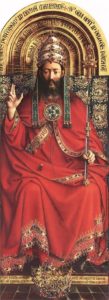
Solemnity of Christ the King

The Solemnity of Our Lord Jesus Christ, King of the Universe, commonly referred to as the Feast of Christ the King or Christ the King Sunday, is a relatively recent addition to the Western liturgical calendar, having been instituted in 1925 by Pope Pius XI for the Roman Rite of the Catholic Church. In 1970 its Roman Rite observance was moved to the final Sunday of Ordinary Time. Therefore, the earliest date on which it can occur is 20 November and the latest is 26 November. The Anglican, Lutheran, and many other Protestant churches also celebrate the Feast of Christ the King, which is contained in the Revised Common Lectionary. Roman Catholics adhering to the Extraordinary Form of the Roman Rite use the General Roman Calendar of 1960, and as such continue to observe the Solemnity on its original date of the final Sunday of October. It is also observed on the same computed date as the final Sunday of the ecclesiastical year, the Sunday before the First Sunday of Advent, by Western rite parishes of the Russian Orthodox Church Outside Russia.

Clement of AlexandriaClement of Alexandria

Clement depicted in 1584

Titus Flavius Clemens, also known as Clement of Alexandria or Saint Clement (Greek: Κλήμης ὁ Ἀλεξανδρεύς; c. 150 – c. 215 AD),[5] was a Christian theologian and philosopher who taught at the Catechetical School of Alexandria. Among his pupils were Origen and Alexander of Jerusalem. A convert to Christianity, he was an educated man who was familiar with classical Greek philosophy and literature. As his three major works demonstrate, Clement was influenced by Hellenistic philosophy to a greater extent than any other Christian thinker of his time, and in particular, by Plato and the Stoics. His secret works, which exist only in fragments, suggest that he was familiar with pre-Christian Jewish esotericism and Gnosticism as well. In one of his works he argued that Greek philosophy had its origin among non-Greeks, claiming that both Plato and Pythagoras were taught by Egyptian scholars.

Clement is usually regarded as a Church Father. He is venerated as a saint in Coptic Christianity, Eastern Catholicism, Ethiopian Christianity, and Anglicanism. He was revered in Western Catholicism until 1586, when his name was removed from the Roman Martyrology by Pope Sixtus V on the advice of Baronius. The Eastern Orthodox Church officially stopped any veneration of Clement of Alexandria in the 10th century.