Author: patron

All Saints’ DayAll Saints’ Day

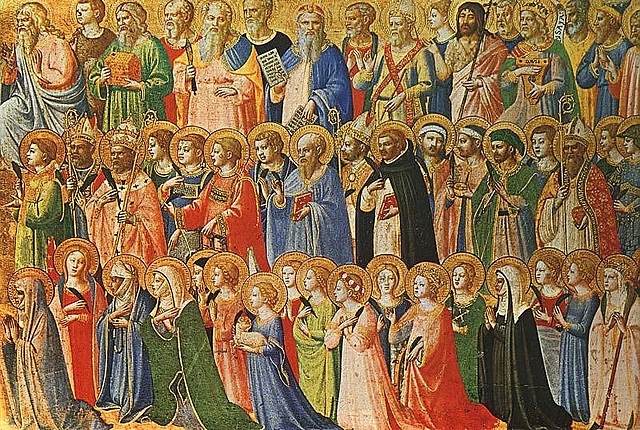
Fresco of various saints

All Saints’ Day, also known as All Hallows’ Day, Hallowmas, the Feast of All Saints, or Solemnity of All Saints, is a Christian festival celebrated in honour of all the saints, known and unknown. In Western Christianity, it is celebrated on November 1 by the Roman Catholic Church, the Anglican Communion, the Methodist Church, the Lutheran Church, the Reformed Church, and other Protestant churches. The Eastern Orthodox Church and associated Eastern Catholic Churches and Byzantine Lutheran Churches celebrate it on the first Sunday after Pentecost. Oriental Orthodox churches of Chaldea and associated Eastern Catholic churches celebrate All Saints’ Day on the first Friday after Easter.

In the Western Christian practice, the liturgical celebration begins at Vespers on the evening of 31 October, All Hallows’ Eve (All Saints’ Eve), and ends at the close of 1 November. It is thus the day before All Souls’ Day, which commemorates the faithful departed. In many traditions, All Saints’ Day is part of the season of Allhallowtide, which includes the three days from 31 October to 2 November inclusive and in some denominations, such as Anglicanism, extends to Remembrance Sunday. On All Saints Day, it is common for families to attend church, as well as visit cemeteries in order to lay flowers and candles on the graves of their deceased loved ones. It is a national holiday in many historically Christian countries.

The Christian celebration of All Saints’ Day and All Souls’ Day stems from a belief that there is a powerful spiritual bond between those in heaven (the “Church triumphant”), and the living (the “Church militant”). In Catholic theology, the day commemorates all those who have attained the beatific vision in Heaven. In Methodist theology, All Saints Day revolves around “giving God solemn thanks for the lives and deaths of his saints”, including those who are “famous or obscure”. As such, individuals throughout the Church Universal are honoured, such as Paul the Apostle, Augustine of Hippo and John Wesley, in addition to individuals who have personally led one to faith in Jesus, such as one’s grandmother or friend.

In the British Isles, it is known that churches were already celebrating All Saints on 1 November at the beginning of the 8th century to coincide with or replace the Celtic festival of Samhain. James Frazer suggests that 1 November was chosen because it was the date of the Celtic festival of the dead (Samhain). However, Ronald Hutton points out that, according to Óengus of Tallaght (d. ca. 824), the 7th/8th century church in Ireland celebrated All Saints on 20 April. He suggests that 1 November date was a Germanic rather than a Celtic idea.
Simon the ZealotSimon the Zealot

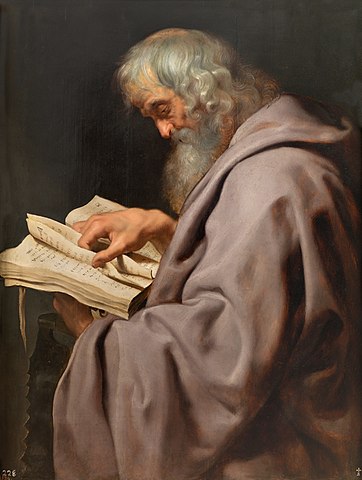
Simon the Zealot

Simon the Zealot or Simon the Canaanite or Simon the Canaanean was one of the most obscure among the apostles of Jesus. A few pseudepigraphical writings were connected to him, but Saint Jerome does not include him in De viris illustribus written between 392 and 393 AD.

The name Simon occurs in all of the Synoptic Gospels and the Book of Acts each time there is a list of apostles, without further details (Luke 6:14-16):

To distinguish him from Simon Peter he is called Kananaios or Kananites, depending on the manuscript (Matthew 10:4 Mark 3:18), and in the list of apostles in Luke 6:15, repeated in Acts 1:13, Zelotes, the “Zealot”. Both Kananaios and Kananites derive from the Hebrew word קנאי qanai, meaning zealous, although Jerome and others mistook the word to signify the apostle was from the town of קנה Cana, in which case his epithet would have been “Kanaios”, or even from the region of כנען Canaan. As such, the translation of the word as “the Cananite” or “the Canaanite” is traditional and without contemporary extra-canonic parallel.

Robert Eisenman has pointed out his contemporary talmudic references to Zealots as kanna’im “but not really as a group—rather as avenging priests in the Temple”. Eisenman’s broader conclusions, that the zealot element in the original apostle group was disguised and overwritten to make it support the assimilative Pauline Christianity of the Gentiles, are more controversial. John P. Meier argues that the term “Zealot” is a mistranslation and in the context of the Gospels means “zealous” or “religious” (in this case, for keeping the Law of Moses), as the Zealot movement apparently did not exist until 30 to 40 years after the events of the Gospels. However, neither Brandon nor Hengel support this view.

Jude the ApostleJude the Apostle

Painting of Saint Jude

Jude, also known as Judas Thaddaeus was one of the Twelve Apostles of Jesus according to the New Testament. He is generally identified with Thaddeus, and is also variously called Jude of James, Jude Thaddaeus, Judas Thaddaeus or Lebbaeus. He is sometimes identified with Jude, the brother of Jesus, but is clearly distinguished from Judas Iscariot, the apostle who betrayed Jesus prior to his crucifixion. Catholic writer Michal Hunt suggests that Judas Thaddaeus became known as Jude after early translators of the New Testament from Greek into English sought to distinguish him from Judas Iscariot and subsequently abbreviated his forename. Most versions of the New Testament in languages other than English and French refer to Judas and Jude by the same name.

The Armenian Apostolic Church honors Thaddeus along with Saint Bartholomew as its patron saints. In the Roman Catholic Church, he is the patron saint of desperate cases and lost causes.

Saint Jude’s attribute is a club. He is also often shown in icons with a flame around his head. This represents his presence at Pentecost, when he received the Holy Spirit with the other apostles. Another common attribute is Jude holding an image of Jesus Christ, known as the Image of Edessa. In some instances, he may be shown with a scroll or a book (the Epistle of Jude) or holding a carpenter’s rule.

James, brother of JesusJames, brother of Jesus

Saint James the Just

James the Just, or a variation of James, brother of the Lord (Latin: Iacomus from Hebrew: יעקב Ya’akov and Greek: Ἰάκωβος Iákōbos, can also be Anglicized as “Jacob”), was the brother of Jesus, according to the New Testament. He was an early leader of the Jerusalem Church of the Apostolic Age, to which Paul was also affiliated. He died in martyrdom in 62 or 69 AD.

Catholics and Eastern Orthodox, as well as some Anglicans and Lutherans, teach that James, along with others named in the New Testament as “brothers” of Jesus, were not the biological children of Mary, but were possibly cousins of Jesus or half-brothers from a previous marriage of Joseph (as related in the Gospel of James).

Roman tradition holds that this James is to be identified with James, son of Alphaeus, and James the Less. It is agreed by most that he should not be confused with James, son of Zebedee.