Category: Christian Saints and Feasts

Saint JosephSaint Joseph

St. Joseph with the Infant Jesus

Joseph is a figure in the Gospels who was married to Mary, Jesus’ mother, and was Jesus’ legal father. Joseph is venerated as Saint Joseph in the Catholic Church, Orthodox Church, Oriental Orthodox Church, Anglicanism, Lutheranism, and Methodism, and is also known as Joseph the carpenter. Some differing views are due to theological interpretations versus historical views.

In both Catholic and Protestant traditions, Joseph is regarded as the patron saint of workers and is associated with various feast days. Pope Pius IX declared him to be both the patron and the protector of the Catholic Church, in addition to his patronages of the sick and of a happy death, due to the belief that he died in the presence of Jesus and Mary. In popular piety, Joseph is regarded as a model for fathers and has also become patron of various dioceses and places.

Several venerated images of Saint Joseph have been granted a canonical coronation by a Pope. In popular religious iconography he is associated with lilies or a spikenard. With the present-day growth of Mariology, the theological field of Josephology has also grown and since the 1950s centers for studying it have been formed.

In the Apocrypha, Joseph was the father of James, Joses, Jude, Simon, and at least two daughters. According to Epiphanius and the apocryphal History of Joseph the Carpenter, these children were from a marriage which predated the one with Mary, a belief that is accepted by some select Christian denominations.

Mary, mother of JesusMary, mother of Jesus

Virgin & Child with angels

Mary (Greek: Μαρία, translit. María; Aramaic: ܡܪܝܡ‎, translit. Mariam‎; Hebrew: מִרְיָם‎, translit. Miriam‎; Arabic: مريم‎, translit. Mariam‎), also known by various titles, styles and honorifics, was a 1st-century Galilean Jewish woman of Nazareth, and the mother of Jesus, according to the New Testament and the Quran.

The gospels of Matthew and Luke in the New Testament and the Quran describe Mary as a virgin (Greek: παρθένος, translit. parthénos) and Christians believe that she conceived her son while a virgin by the Holy Spirit. The miraculous conception took place when she was already betrothed to Joseph and was awaiting the concluding rite of marriage, the formal home-taking ceremony. She married Joseph and accompanied him to Bethlehem, where Jesus was born.

The Gospel of Luke begins its account of Mary’s life with the Annunciation, when the angel Gabriel appeared to Mary and announced her divine selection to be the mother of Jesus. According to canonical gospel accounts, Mary was present at the crucifixion and is depicted as a member of the early Christian community in Jerusalem. According to the Catholic and Orthodox teaching, at the end of her earthly life her body was assumed directly into Heaven; this is known in the Christian West as the Assumption.

Mary has been venerated since early Christianity, and is considered by millions to be the most meritorious saint of the religion. She is claimed to have miraculously appeared to believers many times over the centuries. The Eastern and Oriental Orthodox, Roman Catholic, Anglican, and Lutheran churches believe that Mary, as mother of Jesus, is the Mother of God (Greek: Θεοτόκος, translit. Theotokos, lit. ‘God-bearer’). There is significant diversity in the Marian beliefs and devotional practices of major Christian traditions. The Roman Catholic Church holds distinctive Marian dogmas, namely her status as the Mother of God, her Immaculate Conception, her perpetual virginity, and her Assumption into heaven. Many Protestants minimize Mary’s role within Christianity, based on the argued brevity of biblical references. Mary (Arabic: مريم‎, translit. Maryām‎) also has a revered position in Islam, where one of the longer chapters of the Quran is devoted to her.

The VisitationThe Visitation


Philippe de Champaigne, La Visitation. Museo d...

Philippe de Champaigne, La Visitation. Museo de Arte e Historia de Ginebra (Photo credit: Wikipedia)

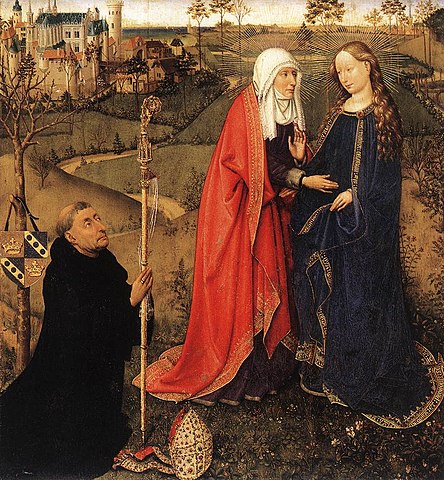
After the angel Gabriel had announced to Mary that she was to become the mother of Our Lord, Mary went from Galilee to Judea to visit her kinswoman Elizabeth, soon to be the mother of John the Baptist. This visit is recorded in Luke 1:39-56. Elizabeth greeted Mary with the words, “Blessed are you among women, and blessed is the fruit of your womb.” Mary burst forth with the song of praise which we call the Magnificat, beginning, “My soul proclaims the greatness of the Lord.” We are told that even John the Baptist, still unborn, leaped for joy in his mother’s womb. Thus we are shown, side by side, the two women, one seemingly too old to have a child, but destined to bear the last prophet of the Old Covenant, of the age that was passing away; and the other woman, seemingly not ready to have a child, but destined to bear the One Who was Himself the beginning of the New Covenant, the age that would not pass away.

THE EXALTATION OF THE HOLY CROSSTHE EXALTATION OF THE HOLY CROSS

During the reign of Constantine, first Roman Emperor to profess the Christian faith, his mother Helena went to Israel and there undertook to find the places especially significant to Christians. (She was helped in this by the fact that in their destructions around 135, the Romans had built pagan shrines over many of these sites.) Having located, close together, what she believed to be the sites of the Crucifixion and of the Burial (at locations that modern archaeologists think may be correct), she then had built over them the Church of the Holy Sepulchre, which was dedicated on 14 September 335. It has become a day for recognizing the Cross (in a festal atmosphere that would be inappropriate on Good Friday) as a symbol of triumph, as a sign of Christ‘s victory over death, and a reminder of His promise, “And when I am lifted up, I will draw all men unto me.” (John 12:32)

The Christian custom of tracing the sign of the cross on persons and things as a sign of blessing is very old. Some think that it goes back to the very origins of Christianity and earlier. In Ezekiel 9, we read that Ezekiel had a vision of the throne-room of God, in which an angel was sent to go through Jerusalem and put a mark on the foreheads of the faithful few who mourned for the sins of the city. Afterwards, other angels were sent through the city to destroy all those who had not the mark. We find similar visionary material in Revelation 7:2-4; 9:4; 14:1, where the mark on the forehead again protects the faithful few in the day of wrath, and it is said to be the name of the Lamb and of His Father.

What is the significance of the sign of the cross? Well, in the first place, we often place our initials or other personal mark on something to show that it belongs to us. The Cross is the personal mark of Our Lord Jesus Christ, and we mark it on ourselves as a sign that we belong to Him, just as in the book of Revelation, as noted above, the servants of God are sealed or marked on their foreheads as a sign that they are His.

James Kiefer