Category: Home

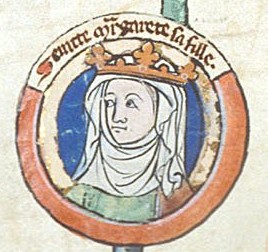
Saint Margaret of ScotlandSaint Margaret of Scotland

Saint Margaret

Saint Margaret of Scotland (Scottish Gaelic: Naomh Maighréad; Scots: Saunt Marget, c. 1045 – 16 November 1093), also known as Margaret of Wessex, was an English princess and a Scottish queen. Margaret was sometimes called “The Pearl of Scotland”. Born in the Kingdom of Hungary to the expatriate English prince Edward the Exile, Margaret and her family returned to England in 1057. Following the death of Harold Godwinson at the Battle of Hastings in 1066, her brother Edgar Ætheling was elected as King of England but never crowned. After she and her family fled north, Margaret married Malcolm III of Scotland by the end of 1070.

Margaret was a very pious Christian, and among many charitable works she established a ferry across the Firth of Forth in Scotland for pilgrims travelling to St Andrews in Fife, which gave the towns of South Queensferry and North Queensferry their names. Margaret was the mother of three kings of Scotland, or four, if Edmund of Scotland (who ruled with his uncle, Donald III) is counted, and of Matilda of Scotland, queen consort of England. According to the Vita S. Margaritae (Scotorum) Reginae (Life of St. Margaret, Queen (of the Scots)), attributed to Turgot of Durham, Margaret died at Edinburgh Castle in Edinburgh, Scotland in 1093, merely days after receiving the news of her husband and son’s deaths in battle.

In 1250, Pope Innocent IV canonised her, and her remains were reinterred in a shrine in Dunfermline Abbey in Fife, Scotland. Her relics were dispersed after the Scottish Reformation and subsequently lost. Mary, Queen of Scots, at one time owned her head, which was subsequently preserved by Jesuits in the Scots College, Douai, France, from where it was lost during the French Revolution.
Martin of Tours (St. Martin)Martin of Tours (St. Martin)

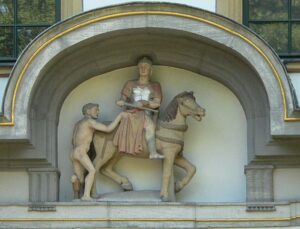
Statue of Saint Martin cutting his cloak in two.

Martin of Tours (Latin: Sanctus Martinus Turonensis; 316/336 – 8 November 397), also known as Martin the Merciful, was the third bishop of Tours. He has become one of the most familiar and recognizable Christian saints in France, heralded as the patron saint of the Third Republic, and is patron saint of many communities and organizations across Europe. A native of Pannonia (in central Europe), he converted to Christianity at a young age. He served in the Roman cavalry in Gaul, but left military service at some point prior to 361, when he became a disciple of Hilary of Poitiers, establishing the monastery at Ligugé. He was consecrated as Bishop of Caesarodunum (Tours) in 371. As bishop, he was active in the suppression of the remnants of Gallo-Roman religion, but he opposed the violent persecution of the Priscillianist sect of ascetics.

His life was recorded by a contemporary hagiographer, Sulpicius Severus. Some of the accounts of his travels may have been interpolated into his vita to validate early sites ofhis cult. He is best known for the account of his using his sword to cut his cloak in two, to give half to a beggar clad only in rags in the depth of winter. His shrine in Tours became a famous stopping-point for pilgrims on the road to Santiago de Compostela in Spain. His cult was revived in French nationalism during the Franco-Prussian War of 1870/1, and as a consequence he was seen as a patron saint of France during the French Third Republic.

Saint LeonardSaint Leonard

Wooden statue of Saint Leonard, Abbot of Noblac

Leonard of Noblac (also Leonard of Limoges or Leonard of Noblet; also known as Lienard, Linhart, Leonhard, Léonard, Leonardo, Annard; died 559), is a Frankish saint closely associated with the town and abbey of Saint-Léonard-de-Noblat, in Haute-Vienne, in the Limousin region of France. He was converted to Christianity along with the king, at Christmas 496. Leonard became a hermit in the forest of Limousin, where he gathered a number of followers. Leonard or Lienard became one of the most venerated saints of the late Middle Ages. His intercession was credited with miracles for the release of prisoners, women in labour and the diseases of cattle.

All Souls’ DayAll Souls’ Day

The Day of the Dead

All Souls’ Day, also known as the Commemoration of All the Faithful Departed and the Day of the Dead, is a day of prayer and remembrance for the souls of those who have died, which is observed by Catholics and other Christian denominations annually on November 2. All Souls’ Day is often celebrated in Western Christianity; Saturday of Souls is a related tradition more frequently observed in Eastern Christianity. Practitioners of All Souls’ Day traditions often remember deceased loved ones in various ways on the day. Beliefs and practices associated with All Souls’ Day vary widely among Christian churches and denominations.

The annual celebration is the last day of Allhallowtide, after All Saints’ Day and its eve. Prior to the standardization of Catholic observance on 2 November by St. Odlio of Cluny during the 10th century, many Catholic congregations celebrated All Souls Day on various dates during the Easter season as it is still observed in some Eastern Orthodox Church and associated Eastern Catholic Churches. Churches of the East Syriac Rite (Syro-Malabar Catholic Church, Chaldean Catholic Church, Assyrian Church of the East, Ancient Church of the East) commemorate all the faithful departed on the Friday before Lent.