Category: Christian Saints and Feasts

The Baptism of Our LordThe Baptism of Our Lord

Baptism of Christ. Jesus is baptized in the Jo...

Baptism of Christ. Jesus is baptized in the Jordan River by John. (Photo credit: Wikipedia)

Today the Church celebrates the Feast of the Baptism of Our Lord. This brings to an end the season of Christmas. The Church recalls Our Lord’s second manifestation or epiphany which occurred on the occasion of His baptism in the Jordan. In the Eastern Church this feast is called Theophany because at the baptism of Christ in the River Jordan God appeared in three persons. Many of the incidents which accompanied Christ’s baptism are symbolical of what happened at our Baptism. At Christ’s baptism the Holy Spirit descended upon Him; at our Baptism the Trinity took its abode in our soul. At His baptism Christ was proclaimed the “Beloved Son” of the Father; at our Baptism we become the adopted sons of God. At Christ’s baptism the heavens were opened; at our Baptism heaven was opened to us. At His baptism Jesus prayed; after our Baptism we must pray to avoid actual sin.

Feast of the Holy Name of JesusFeast of the Holy Name of Jesus

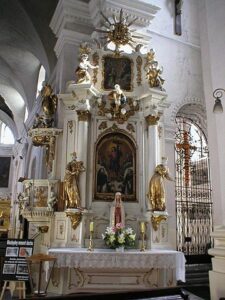
Altar of the Holy Name of Jesus

The feast of the Holy Name of Jesus has been celebrated in the Roman Catholic Church, at least at local levels, since the end of the fifteenth century. The celebration has been held on different dates, usually in January, because 1 January, eight days after Christmas, commemorates the naming of the child Jesus; as recounted in the Gospel read on that day, “at the end of eight days, when he was circumcised, he was called Jesus, the name given by the angel before he was conceived in the womb.” Medieval Catholicism, and many Christian churches to the present day, therefore celebrated both events as the Feast of the Circumcision of Christ, usually on 1 January. An Office and Mass were approved by Pope Sixtus IV.

Observance of the feast was officially granted to the Franciscans in 1530 and spread over a great part of the Church. The Franciscans, Carmelites, and Augustinians kept the feast on 14 January, the Dominicans on 15 January. At Salisbury, York, and Durham in England, and at Aberdeen in Scotland it was celebrated 7 August, at Liège in Belgium, 31 January, at Compostela in Spain and Cambrai in France, 8 January.

Around 1643 the Carthusians obtained the second Sunday after Epiphany for the Feast. This was the date assigned to the celebration when, on 20 December 1721, it was inserted into the General Calendar of the Roman Rite by Pope Innocent XIII. In the reform of Pope Pius X, enacted by his motu proprio Abhinc duos annos of 23 October 1913, it was moved to the Sunday between 2 and 5 January inclusive, and in years when no such Sunday existed the celebration was observed on 2 January; this is still observed by Catholics following calendars of 1914 to 1962.

The reform of the liturgical calendar by the motu proprio Mysterii Paschalis of 14 February 1969 removed the feast “since the imposition of the name of Jesus is already commemorated in the office of the Octave of Christmas.” However, the Mass texts of the Holy Name of Jesus were preserved, being placed with the Votive Masses. The celebration was restored to the General Roman Calendar with the 2002 Roman Missal.

PentecostPentecost

Pentecost

Pentecost (Photo credit: Lawrence OP)

Pentecost (Ancient Greek: Πεντηκοστή [ἡμέρα], Pentēkostē [hēmera], “the fiftieth [day]”) is the Greek name for the Feast of Weeks, a prominent feast in the calendar of ancient Israel celebrating the giving of the Law on Sinai.

This feast is still celebrated in Judaism as Shavuot.

Later, in the Christian liturgical year, it became a feast commemorating the descent of the Holy Spirit upon the Apostles and other followers of Jesus Christ (120 in all), as described in the Acts of the Apostles 2:1–31.

For this reason, Pentecost is sometimes described by some Christians today as the “Birthday of the Church“.

In the Eastern church, Pentecost can also refer to the whole fifty days between Easter and Pentecost, hence the book containing the liturgical texts for Paschaltide is called the Pentecostarion.

The feast is also called White Sunday, or Whitsunday, especially in England, where the following Monday was traditionally a public holiday.

The Talmud refers to Shavuot as Atzeret (Hebrew: עצרת, literally, “refraining” or “holding back”), referring to the prohibition against work on this holiday and to the conclusion of the holiday and season of Passover.

Since Shavuot occurs 50 days after Passover, Hellenistic Jews gave it the name Pentecost.(πεντηκοστή, “fiftieth day”).

According to Jewish tradition, Pentecost commemorates God giving the Ten Commandments at Mount Sinai fifty days after the Exodus.

Present were about one hundred and twenty followers of Christ (Acts 1:15), including the Twelve Apostles (i.e. the Eleven faithful disciples and Matthias who was Judas’ replacement) (Acts 1:13, 26), his mother Mary, various other women disciples and his brothers (Acts 1:14).

Their reception of Baptism in the Holy Spirit in the Upper Room is recounted in Acts 2:1–6. While those on whom the Spirit had descended were speaking in many languages, the Apostle Peter stood up with the eleven and proclaimed to the crowd that this event was the fulfillment of the prophecy (“I will pour out my spirit”).

According to the current Jewish Calendar, the date of Pentecost is fifty days from Passover.

Since the date of Easter is calculated differently in the East and West (see Easter controversy), in most years the two traditions celebrate Pentecost on different days (though in some years the celebrations will coincide, as in 2010, 2011, and 2014).

In the Eastern Orthodox Church, Pentecost is one of the Orthodox Great Feasts and is considered to be the highest ranking Great Feast of the Lord, second in rank only to Easter/Resurrection Sunday/Passover.

Theologically, Orthodox do not consider Pentecost to be the “birthday” of the Church; they see the Church as having existed before the creation of the world.

They may depict symbols of the Holy Spirit, such as the dove or flames, symbols of the church such as Noah’s Ark and the Pomegranate, or especially within Protestant churches of Reformed and Evangelical traditions, words rather than images naming for example, the gifts and Fruits of the Spirit.

While this practice is common among a wide spectrum of Western denominations (Eastern Churches do not employ instrumental accompaniment in their worship) it is particularly typical, and distinctive to the heritage of the Moravian Church.

The Pentecost Novena is considered the first Novena, all other Novenas offered in preparation of various festivals and Saints days deriving their practice from those original nine days of prayer observed by the disciples of Christ.

The holiday was also one of the three days each year (along with Christmas and Easter) Roman Catholics were required to confess and receive the sacrament of Holy Communion in order to remain in good church standing.
Palm Sunday (or Passion Sunday)Palm Sunday (or Passion Sunday)

English: Description: Left Apsis: Jesus enteri...

English: Description: Left Apsis: Jesus entering Jerusalem on Palm Sunday. Fresco in the Parish Church of Zirl, Austria. (Photo credit: Wikipedia)

Holy week begins with the sixth Sunday in Lent. This Sunday observes the triumphal entry of Jesus into Jerusalem that was marked by the crowds who were in Jerusalem for Passover waving palm branches and proclaiming him as the messianic king. The Gospels tell us that Jesus rode into the city on a donkey, enacting the prophecy of Zechariah 9:9 and in so doing emphasized the humility that was to characterize the Kingdom he proclaimed. The irony of his acceptance as the new Davidic King (Mark 11:10) by the crowds who would only five days later cry for his execution should be a sobering reminder of the human tendency to want God on our own terms.

Traditionally, worshippers enact the entry of Jesus into Jerusalem by the waving of palm branches and singing songs of celebration. Sometimes this is accompanied by a processional into the church.

This Sunday is also known as Passion Sunday to commemorate the beginning of Holy Week and Jesus’ final agonising journey to the Cross. The English word passion comes from a Latin word that means ‘to suffer,’ the same word from which we derive the English word patient.

In most Protestant traditions, the liturgical colour for The Season of Lent is purple, and that colour is used until Easter Sunday. In Catholic tradition (and some others), the colours are changed to Red for Palm Sunday. Red is the colour of the church, used for Pentecost as well as remembering the martyrs of the church. Since it symbolizes shed blood, it is also used on Palm Sunday to symbolize the death of Jesus. While most Protestants celebrate the Sunday before Easter as Palm Sunday, in Catholic and other church traditions it is also celebrated as Passion Sunday anticipating the impending death of Jesus. In some Church traditions (Anglican), the church colours are changed to red for the fifth Sunday in Lent, with the last two Sundays observed as Passiontide.

Increasingly, many churches are incorporating an emphasis on the Passion of Jesus into services on Palm Sunday as a way to balance the celebration of Easter Sunday.