Category: Christian Saints and Feasts

The Holy InnocentsThe Holy Innocents

Matteo di Giovanni 002.jpg

By Matteo di Giovanni – The Yorck Project: 10.000 Meisterwerke der Malerei. DVD-ROM, 2002. ISBN 3936122202. Distributed by DIRECTMEDIA Publishing GmbH., Public Domain, Link

The Massacre of the Innocents is the biblical account of infanticide by Herod the Great, the Roman-appointed King of the Jews. According to the Gospel of Matthew, Herod ordered the execution of all young male children in the vicinity of Bethlehem, so as to avoid the loss of his throne to a newborn King of the Jews whose birth had been europaisches-roulette announced to him by the Magi. In typical Matthean style, it is understood as the fulfillment of an Old Testament prophecy:

Then was fulfilled that which was spoken through Jeremiah the prophet, saying, “A voice is heard in Ramah, mourning and great weeping, Rachel weeping for her children and refusing to be comforted, because her children are no more.”

The number of infants killed is not stated. The Holy Innocents, although Jewish, have been claimed as martyrs for Christianity, and the Feast of the Holy Innocents has long been celebrated.

Since the sole evidence for the event occurs in the Gospel of Matthew, New Testament scholars treat its historicity as an open question; and biographers of Herod deny that the event occurred.

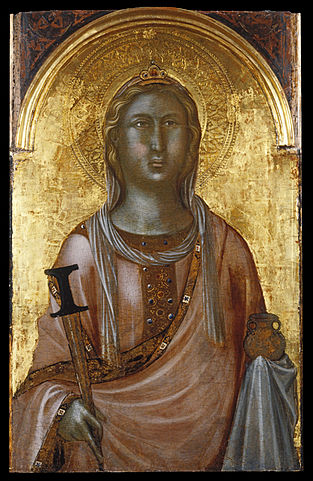
Saint LucySaint Lucy

Saint Lucy

Lucia of Syracuse (283–304), also called Saint Lucia (Latin:Sancta Lucia) or Saint Lucy, was a Christian martyr who died during the Diocletianic Persecution. She is venerated as a saint in the Roman Catholic, Anglican, Lutheran, and Eastern Orthodox churches. She is one of eight women (including Saint Mary) explicitly commemorated by Roman Catholics in the Canon of the Mass. Her traditional feast day, known in Europe as Saint Lucy’s Day, is observed by Western Christians on 13 December. Lucia of Syracuse was honored in the Middle Ages and remained a well known saint in early modern England.

Feast of the Immaculate ConceptionFeast of the Immaculate Conception

The Solemnity of the Immaculate Conception, also called Immaculate Conception Day, celebrates the sinless lifespan and Immaculate Conception of the Blessed Virgin Mary on 8 December, nine months before the feast of the Nativity of Mary, celebrated on 8 September. It is one of the most important Marian feasts in the liturgical calendar of the Roman Catholic Church celebrated worldwide.

By Pontifical decree, it is the patronal feast day of Argentina, Brazil, Chile, Italy, Korea, Nicaragua, Paraguay, the Philippines, Spain, the United States, and Uruguay. By royal decree, it is designated as the day honoring the patroness of Portugal. It is celebrated by the Roman Catholic Church and some select Protestant Christian denominations.

Since 1953, the Pope visits the Column of the Immaculate Conception in the Piazza di Spagna to offer expiatory prayers commemorating the solemn event.

The feast was first solemnized as a Holy day of obligation on 6 December 1708 under the Papal Bull Commissi Nobis Divinitus by Pope Clement XI and is often celebrated with Catholic Mass, parades, fireworks, processions, food, and cultural festivities in honour of the Blessed Virgin Mary and is generally considered a Family Day, especially in many pious Catholic countries.

Augustine of HippoAugustine of Hippo

Saint Augustine by Justus van Gent

Augustine of Hippo (/ɔːˈɡʌstɪn/ or /ˈɔːɡəstiːn/; 13 November 354 – 28 August 430) was an early Christian theologian and philosopher whose writings influenced the development of Western Christianity and Western philosophy. He was the bishop of Hippo Regius in north Africa and is viewed as one of the most important Church Fathers in Western Christianity for his writings in the Patristic Era. Among his most important works are The City of God and Confessions.

According to his contemporary, Jerome, Augustine “established anew the ancient Faith.” In his early years, he was influenced by Manichaeism and afterward by the neo-Platonism of Plotinus. After his baptism and conversion to Christianity in 386, Augustine developed his own approach to philosophy and theology, accommodating a variety of methods and perspectives. Believing that the grace of Christ was indispensable to human freedom, he helped formulate the doctrine of original sin and made seminal contributions to the development of just war theory. When the Western Roman Empire began to disintegrate, Augustine developed the concept of the Church as a spiritual City of God, distinct from the material Earthly City. His thoughts profoundly influenced the medieval worldview. The segment of the Church that adhered to the concept of the Trinity as defined by the Council of Nicaea and the Council of Constantinople closely identified with Augustine’s On the Trinity.

Augustine is recognized as a saint in the Catholic Church, the Eastern Christian Church, and the Anglican Communion and as a preeminent Doctor of the Church. He is also the patron of the Augustinians. His memorial is celebrated on 28 August, the day of his death. Augustine is the patron saint of brewers, printers, theologians, the alleviation of sore eyes, and a number of cities and dioceses. Many Protestants, especially Calvinists and Lutherans, consider him to be one of the theological fathers of the Protestant Reformation due to his teachings on salvation and divine grace. Lutherans, and Martin Luther in particular, have held Augustine in preeminence (after the Bible and St. Paul). Luther himself was a member of the Order of the Augustinian Eremites (1505–1521).

In the East, some of his teachings are disputed and have in the 20th century in particular come under attack by such theologians as John Romanides. But other theologians and figures of the Eastern Orthodox Church have shown significant appropriation of his writings, chiefly Georges Florovsky. The most controversial doctrine surrounding his name is the filioque, which has been rejected by the Orthodox Church. Other disputed teachings include his views on original sin, the doctrine of grace, and predestination. Nevertheless, though considered to be mistaken on some points, he is still considered a saint, and has even had influence on some Eastern Church Fathers, most notably Saint Gregory Palamas. In the Orthodox Church his feast day is celebrated on 15 June. Church scholar and historian Diarmaid MacCulloch writes “his impact on Western Christian thought can hardly be overstated; only his beloved example Paul of Tarsus, has been more influential, and Westerners have generally seen Paul through Augustine’s eyes.”
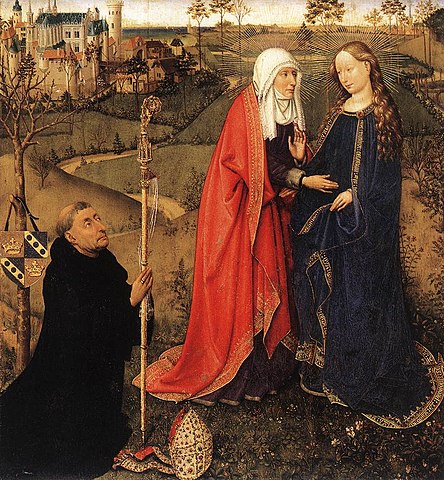
The Visitation of the Blessed Virgin Mary to ElizabethThe Visitation of the Blessed Virgin Mary to Elizabeth

Visitation by Jacques Daret

In Christianity, the Visitation is the visit of Mary, who was pregnant with Jesus, to Elizabeth, who was pregnant with John the Baptist, in the Gospel of Luke, Luke 1:39–56.

It is also the name of a Christian feast day commemorating this visit, celebrated on 31 May in the feast-celebrating branches of Western Christianity (most and mainstream calendars of Catholics and High Church Anglicans) or as 2 July in calendars of 1263–1969, (retained in the modern calendar of some countries whose bishops’ conferences wanted to retain this, notably Germany and Slovakia) and 30 March in Eastern Christianity.

The episode is one of the standard scenes shown in cycles of the Life of the Virgin in art, and sometimes in larger cycles of the Life of Christ in art.