Category: Christian Saints and Feasts

James, brother of JesusJames, brother of Jesus

Saint James the Just

James the Just, or a variation of James, brother of the Lord (Latin: Iacomus from Hebrew: יעקב Ya’akov and Greek: Ἰάκωβος Iákōbos, can also be Anglicized as “Jacob”), was the brother of Jesus, according to the New Testament. He was an early leader of the Jerusalem Church of the Apostolic Age, to which Paul was also affiliated. He died in martyrdom in 62 or 69 AD.

Catholics and Eastern Orthodox, as well as some Anglicans and Lutherans, teach that James, along with others named in the New Testament as “brothers” of Jesus, were not the biological children of Mary, but were possibly cousins of Jesus or half-brothers from a previous marriage of Joseph (as related in the Gospel of James).

Roman tradition holds that this James is to be identified with James, son of Alphaeus, and James the Less. It is agreed by most that he should not be confused with James, son of Zebedee.

Luke the EvangelistLuke the Evangelist

Saint Luke

Luke the Evangelist (Latin: Lūcās, Ancient Greek: Λουκᾶς, Loukãs, Hebrew: לוקאס‎‎, Lūqās, Aramaic: לוקא‏‎‎‎, Lūqā’‎) is one of the Four Evangelists—the four traditionally ascribed authors of the canonical Gospels. The early church fathers ascribed to him authorship of both the Gospel according to Luke and the book of Acts of the Apostles, which would mean Luke contributed over a quarter of the text of the New Testament, more than any other author. Prominent figures in early Christianity such as Jerome and Eusebius later reaffirmed his authorship, although the fragile evidence of the identity of the author of the works has led to discussion in scholarly circles, both secular and religious.

The New Testament mentions Luke briefly a few times, and the Pauline epistle to the Colossians refers to him as a physician (from Greek for ‘one who heals’); thus he is thought to have been both a physician and a disciple of Paul. Christians since the faith’s early years have regarded him as a saint. He is believed to have been a martyr, reportedly as having been hanged from an olive tree, though some believe otherwise.

The Roman Catholic Church and other major denominations venerate him as Saint Luke the Evangelist and as a patron saint of artists, physicians, bachelors, surgeons, students and butchers; his feast day takes place on 18 October.

Philip the EvangelistPhilip the Evangelist

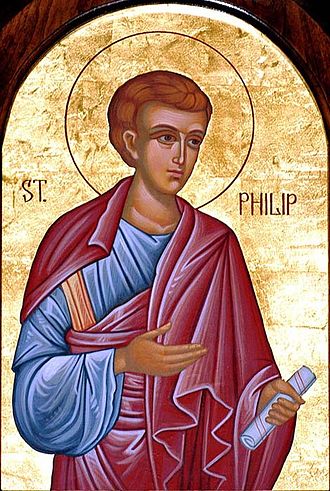
St. Philip the Evangelist

San Filippo diacono

Philip the Evangelist (Greek: Φίλιππος, Philippos) appears several times in the Acts of the Apostles. According to the work, he was one of the Seven chosen to care for the poor of the Christian community in Jerusalem (Acts 6). He preached and performed miracles in Samaria, and met and baptised an Ethiopian man, a eunuch, on the road from Jerusalem to Gaza, traditionally marking the start of the Ethiopian Church (Acts 8:26–39). Later, Philip lived in Caesarea Maritima with his four daughters who prophesied, where he was visited by Paul the Apostle (Acts 21:8–9).

MichaelmasMichaelmas

Michael and the dragon

Michaelmas (/ˈmɪkəlməs/; also known as the Feast of Saints Michael, Gabriel, and Raphael, the Feast of the Archangels, or the Feast of Saint Michael and All Angels) is a minor Christian festival observed in some Western liturgical calendars on 29 September. In some denominations a reference to a fourth angel, usually Uriel, is also added. Michaelmas has been one of the four quarter days of the financial year. The Serbian Orthodox Church observes the feast, whereas most Eastern Orthodox Churches do not. The Greek and Romanian Orthodox honor the archangels on 8 November instead, observed by the Cherubim and Seraphim also.

In Christian angelology, the Archangel Michael is the greatest of all the Archangels and is honored for defeating Satan in the war in heaven. He is one of the principal angelic warriors, seen as a protector against the dark of night, and the administrator of cosmic intelligence. Michaelmas has also delineated time and seasons for secular purposes, as well, particularly in Britain and Ireland as one of the quarter days.

Matthew the ApostleMatthew the Apostle

Matthew the Apostle (also known as Saint Matthew and as Levi), was according to the Bible, one of the twelve apostles of Jesus and, according to Christian tradition, one of the four Evangelists.

Among the early followers and apostles of Jesus, Matthew is mentioned in Matthew 9:9 and Matthew 10:3 as a publican who, while sitting at the “receipt of custom” in Capernaum, was called to follow Jesus. Matthew may have collected taxes from the Hebrew people for Herod Antipas. Matthew is also listed among the twelve, but without identification of his background, in Mark 3:18, Luke 6:15 and Acts 1:13. In passages parallel to Matthew 9:9, both Mark 2:14 and Luke 5:27 describe Jesus’ calling of the tax collector Levi, the son of Alphaeus, but Mark and Luke never explicitly equate this Levi with the Matthew named as one of the twelve.