Category: Christian Saints and Feasts

James the ApostleJames the Apostle

James, son of Zebedee (Hebrew: יַעֲקֹב‎ Yaʿqob, Greek: Ἰάκωβος; died 44 AD) was one of the Twelve Apostles of Jesus, and traditionally considered the first apostle to be martyred. He was a son of Zebedee and Salome, and brother of John the Apostle. He is also called James the Greater or James the Great to distinguish him from James, son of Alphaeus and James the brother of Jesus (James the Just). James the son of Zebedee is the patron saint of Spaniards, and as such is often identified as Santiago.

The son of Zebedee and Salome, James is styled “the Greater” to distinguish him from the Apostle James “the Less”. He was the brother of John, the beloved disciple, and probably the elder of the two.

His parents seem to have been people of means. Zebedee, his father, was a fisherman of the Sea of Galilee, who probably lived in or near Bethsaida, present Galilee, Israel, perhaps in Capernaum, and had some boatmen or hired men. Salome, his mother, was one of the pious women who afterwards followed Christ and “ministered unto him of their substance”, and his brother John was personally known to the high-priest, and must have had wherewithal to provide for the Mother of Jesus.

It is probable that his brother had not received the technical training of the rabbinical schools; in this sense they were unlearned and without any official position among the Jews. But, according to the social rank of their parents, they must have been men of ordinary education, in the common walks of Jewish life. James is described as one of the first disciples to join Jesus. The Synoptic Gospels state that James and John were with their father by the seashore when Jesus called them to follow him. [Matt. 4:21-22][Mk. 1:19-20] James was one of only three apostles whom Jesus selected to bear witness to his Transfiguration. James and John (or, in another tradition, their mother) asked Jesus to grant them seats on his right and left in his glory. Jesus rebuked them, and the other ten apostles were annoyed with them. James and his brother wanted to call down fire on a Samaritan town, but were rebuked by Jesus. [Lk 9:51-6] The Acts of the Apostles records that “Herod the king” (traditionally identified with Herod Agrippa) had James executed by sword. He is the only apostle whose martyrdom is recorded in the New Testament. He is, thus, traditionally believed to be the first of the twelve apostles martyred for his faith. [Acts 12:1-2] Nixon suggests that this may have been caused by James’ fiery temper, for which he and his brother earned the nickname Boanerges or “Sons of Thunder”. [Mark 3:17] F. F. Bruce contrasts this story to that of the Liberation of Saint Peter, and notes that “James should die while Peter should escape” is a “mystery of divine providence”.

The English name “James” comes from Italian “Giacomo”, a variant of “Giacobo” derived from Iacobus (Jacob) in Latin, itself from the Greek Ἰάκωβος “Iakōbos”, from Hebrew יַעֲקֹב. In French, Jacob evolves into “Jacques”. In eastern Spain, Iacobus (Jacobus) became “Jacome” or “Jaime”; in Catalan language, it became “Jaume”. Santiago is the local Galician or Spanish (Castilian) evolution of Vulgar Latin Sanctu Iacobu “Saint James”. “Tiago” is a popular deglutination native to Portuguese language (santiago > san-tiago = São Tiago); it crossed with old Diago to give “Diego” in Spanish and “Diogo” in Portuguese, which is also the Spanish name of Saint Didacus of Alcalá.[citation needed] For example, Miguel de Cervantes in his famous Don Quixote uses “San Diego” instead of “Santiago”.

Saint ChristopherSaint Christopher

Saint Christopher (Greek: Ἅγιος Χριστόφορος, Ágios Christóforos) is venerated by several Christian denominations as a martyr killed in the reign of the 3rd-century Roman Emperor Decius (reigned 249–251) or alternatively under the Roman Emperor Maximinus II Dacian (reigned 308–313). There appears to be confusion due to the similarity in names “Decius” and “Dacian”. However his veneration only appears late in Christian tradition, and did not become widespread in the Western Church until the Late Middle Ages, although churches and monasteries were named after him by the 7th century.

It is disputed whether Christopher existed, and if so whether the name applied to a specific person or was a general title meaning “Christ-bearer” which was applied to several different real or legendary people. He may be the same figure as Saint Menas. His most famous legend, which is mainly known from the West and may draw from Ancient Greek mythology, tells that he carried a child, who was unknown to him, across a river before the child revealed himself as Christ. Therefore, he is the patron saint of travelers, and small images of him are often worn around the neck, on a bracelet, carried in a pocket, or placed in vehicles by Christians.

There are several legends associated with the life and death of Saint Christopher which first appeared in Greece and had spread to France by the 9th century. The 11th-century bishop and poet, Walter of Speyer, gave one version, but the most popular variations originated from the 13th-century Golden Legend.

According to the legendary account of his life Christopher was initially called Reprobus. He was a Canaanite, 5 cubits (7.5 feet (2.3 m)) tall and with a fearsome face. While serving the king of Canaan, he took it into his head to go and serve “the greatest king there was”. He went to the king who was reputed to be the greatest, but one day he saw the king cross himself at the mention of the devil. On thus learning that the king feared the devil, he departed to look for the devil. He came across a band of marauders, one of whom declared himself to be the devil, so Christopher decided to serve him. But when he saw his new master avoid a wayside cross and found out that the devil feared Christ, he left him and enquired from people where to find Christ. He met a hermit who instructed him in the Christian faith. Christopher asked him how he could serve Christ. When the hermit suggested fasting and prayer, Christopher replied that he was unable to perform that service. The hermit then suggested that because of his size and strength Christopher could serve Christ by assisting people to cross a dangerous river, where they were perishing in the attempt. The hermit promised that this service would be pleasing to Christ.

After Christopher had performed this service for some time, a little child asked him to take him across the river. During the crossing, the river became swollen and the child seemed as heavy as lead, so much that Christopher could scarcely carry him and found himself in great difficulty. When he finally reached the other side, he said to the child: “You have put me in the greatest danger. I do not think the whole world could have been as heavy on my shoulders as you were.” The child replied: “You had on your shoulders not only the whole world but Him who made it. I am Christ your king, whom you are serving by this work.” The child then vanished.

Christopher later visited Lycia and there comforted the Christians who were being martyred. Brought before the local king, he refused to sacrifice to the pagan gods. The king tried to win him by riches and by sending two beautiful women to tempt him. Christopher converted the women to Christianity, as he had already converted thousands in the city. The king ordered him to be killed. Various attempts failed, but finally Christopher was beheaded.

Saint Mary MagdaleneSaint Mary Magdalene

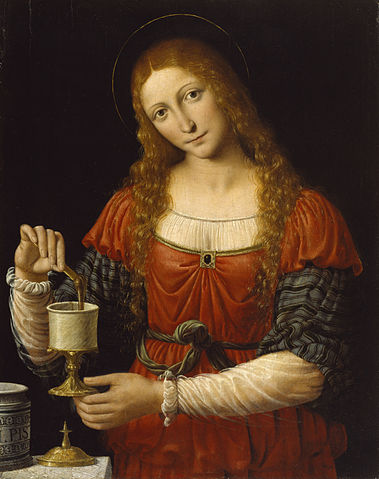
Mary Magdalene by Andrea Solario

Mary Magdalene, sometimes called Mary of Magdala, or simply the Magdalene or the Madeleine, was a woman who, according to the four canonical gospels, traveled with Jesus as one of his followers and was a witness to his crucifixion and its aftermath. She was mentioned by name twelve times in the canonical gospels, more than most of the apostles and more than any other woman in the gospels, other than Jesus’s family. Mary’s epithet Magdalene may mean that she came from the town of Magdala, a fishing town on the western shore of the Sea of Galilee in Roman Judea.

Saint SwithunSaint Swithun

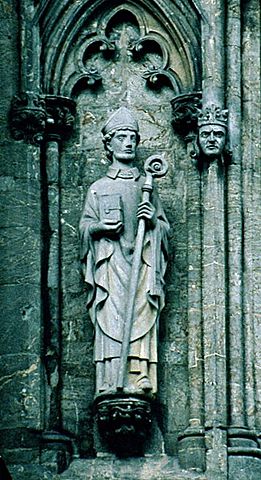
Sculpture of St. Swithun at Stavanger Cathedral

Swithun (or Swithin; Old English: Swīþhūn; Latin: Swithunus; died 863 AD) was an Anglo-Saxon bishop of Winchester and subsequently patron saint of Winchester Cathedral. His historical importance as bishop is overshadowed by his reputation for posthumous miracle-working. According to tradition, if it rains on Saint Swithun’s bridge (Winchester) on his feast day (15 July) it will continue for forty days. The name was originally spelt Swithhun (Old English: “strong bear-cub”).

Saint SilasSaint Silas

Apostle Silas

Apostle Silas (Photo credit: Wikipedia)

Silas or Silvanus was a leading member of the Early Christian community, who later accompanied Paul on parts of his first and second missionary journeys.

Silas is traditionally assumed to be the Silvanus mentioned in four epistles. Some translations, including the New International Version, call him Silas in the epistles. Paul, Silas and Timothy are listed as coauthors of the two letters to the Thessalonians. Second Corinthians mentions Silas as having preached with Paul and Timothy to the church in Corinth (2 Corinthians 1:19) and Peter‘s first epistle regards Silas as a faithful brother (1 Peter 5:12).