Category: Christian Saints and Feasts

Paul the ApostlePaul the Apostle

Paul the Apostle

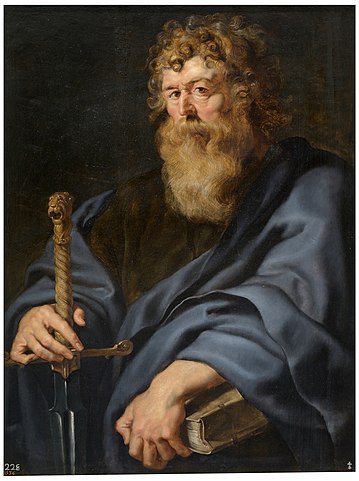
Paul the Apostle, original name Saul of Tarsus, was an apostle (though not one of the Twelve Apostles) who taught the Gospel of Christ to the first-century world. He is generally considered one of the most important apostolic figures of The Apostolic Age. In the mid-30s to mid-50s, he founded several churches in Asia Minor and Europe. Paul used his status as both a Jew and a Roman citizen to advantage in his ministry to both Jewish and Roman audiences.

Fourteen of the twenty-seven books in the New Testament have traditionally been attributed to Paul, and approximately half of the Acts of the Apostles deals with Paul’s life and works. Seven of the epistles are undisputed by scholars as being authentic, with varying degrees of argument about the remainder. The Pauline authorship of Hebrews, already doubted in the 2nd and 3rd centuries but almost unquestioningly accepted from the 5th to the 16th centuries, is now almost universally rejected by scholars. The other six are believed by some scholars to have come from followers writing in his name, using material from Paul’s surviving letters and letters written by him that no longer survive. Other scholars argue that the idea of a pseudonymous author for the disputed epistles raises many problems.

Today, his epistles continue to be deeply rooted in the theology, worship, and pastoral life in the Roman and Protestant traditions of the West, as well as the Orthodox traditions of the East. Among the many other apostles and missionaries involved in the spread of the Christian faith, his influence on Christian thought and practice has been characterized as being as “profound as it is pervasive.” Augustine of Hippo developed Paul’s idea that salvation is based on faith and not “works of the law.” Martin Luther’s interpretation of Paul’s writings heavily influenced Luther’s doctrine of sola fide.
EpiphanyEpiphany

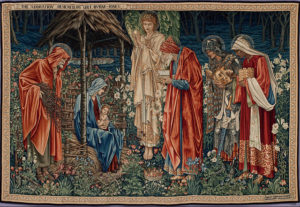
The Adoration of the Magi (Painting)

Epiphany, also Theophany or Three Kings Day is a Christian feast day that celebrates the revelation of God in his Son as the incarnation of Jesus Christ. In Western Christianity, the feast commemorates principally (but not solely) the visit of the Magi to the Christ child, and thus Jesus’ physical manifestation to the Gentiles. Moreover, the feast of the Epiphany, in some Western Christian denominations, also initiates the liturgical season of Epiphanytide. Eastern Christians, on the other hand, commemorate the baptism of Jesus in the Jordan River, seen as his manifestation to the world as the Son of God.

The traditional date for the feast is January 6. However, since 1970, the celebration is held in some countries on the Sunday after January 1. Eastern Churches following the Julian calendar observe the feast on what for most countries is January 19 because of the 13-day difference today between that calendar and the generally used Gregorian calendar. In many Western Christian Churches, the eve of the feast is celebrated as Twelfth Night. The Monday after Epiphany is known as Plough Monday.

Popular Epiphany customs include Epiphany singing, chalking the door, having one’s house blessed, consuming Three Kings Cake, winter swimming, as well as attending church services. It is customary for Christians in many localities to remove their Christmas decorations on Epiphany Eve (Twelfth Night), although those in other Christian countries historically remove them on Candlemas, the conclusion of Epiphanytide. According to the first tradition, those who fail to remember to remove their Christmas decorations on Epiphany Eve must leave them untouched until Candlemas, the second opportunity to remove them; failure to observe this custom is considered inauspicious.

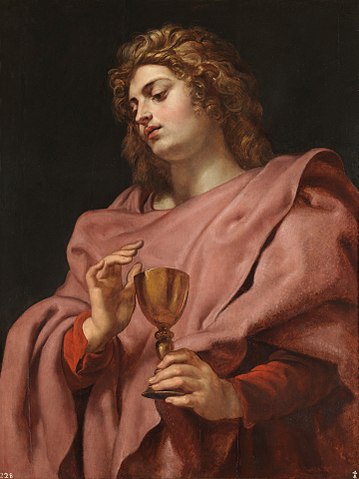
John the ApostleJohn the Apostle

John the Apostle, detail of the mosaic in the Basilica of San Vitale, Ravenna, 6th century

John the Apostle, detail of the mosaic in the Basilica of San Vitale, Ravenna, 6th century

John the Apostle (Ancient Greek: Ἰωάννης; Latin: Ioannes c. 6 AD – c. 100 AD; Ge’ez: ዮሐንስ;) or Saint John the Beloved was one of the Twelve Apostles of Jesus according to the New Testament. Generally listed as the youngest apostle, he was the son of Zebedee and Salome. His brother James was another of the Twelve Apostles. The Church Fathers identify him as John the Evangelist, John of Patmos, John the Elder, and the Beloved Disciple, and testify that he outlived the remaining apostles and was the only one to die of natural causes, although modern scholars are divided on the veracity of these claims.

John the Apostle is traditionally held to be the author of the Gospel of John, and many Christian denominations believe that he authored several other books of the New Testament (the three Johannine epistles and the Book of Revelation, together with the Gospel of John, are called the Johannine works), depending on whether he is distinguished from, or identified with, John the Evangelist, John the Elder, and John of Patmos.

Although the authorship of the Johannine works has traditionally been attributed to John the Apostle, only a minority of contemporary scholars believe he wrote the gospel, and most conclude that he wrote none of them. Regardless of whether or not John the Apostle wrote any of the Johannine works, most scholars agree that all three epistles were written by the same author and that the epistles did not have the same author as the Book of Revelation, although there is widespread disagreement among scholars as to whether the author of the epistles was different from that of the gospel.

Saint StephenSaint Stephen

Saint Stephen

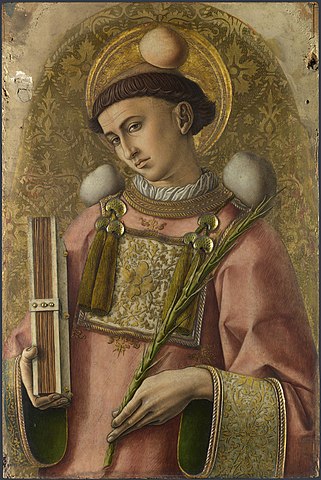
Stephen (GreekΣτέφανος Stéphanos, meaning “wreath, crown” and by extension “reward, honor, renown, fame”, often given as a title rather than as a name; Hebrewסטפנוס הקדושStephanos HaQadosh; c. 5 – c. 34 AD) traditionally venerated as the protomartyr or first martyr of Christianity, was, according to the Acts of the Apostles, a deacon in the early Church at Jerusalem who angered members of various synagogues by his teachings. Accused of blasphemy at his trial, he made a speech denouncing the Jewish authorities who were sitting in judgment on him and was then stoned to death. His martyrdom was witnessed and participated by Saul of Tarsus, also known as Paul, a Pharisee and Roman citizen who would later become a Christian apostle.

The only source for information about Stephen is the New Testament book of the Acts of the Apostles. Stephen is mentioned in Acts 6 as one of the Greek-speaking Hellenistic Jews selected to participate in a fairer distribution of welfare to the Greek-speaking widows.

The CatholicAnglicanOriental OrthodoxEastern Orthodox ChurchesLutheran and the Church of the East view Stephen as a saint. Artistic representations often show Stephen with a crown symbolising martyrdom, three stones, martyr’s palm frondcenser, and often holding a miniature church building. Stephen is often shown as a young, beardless man with a tonsure, wearing a deacon’s vestments.

ChristmasChristmas

English: Jesus Christ - detail from Deesis mos...

English: Jesus Christ – detail from Deesis mosaic, Hagia Sophia, Istanbul (Photo credit: Wikipedia)

Christmas or Christmas Day is an annual festival commemorating the birth of Jesus Christ observed most commonly on December 25 as a religious and cultural celebration among billions of people around the world. A feast central to the Christian liturgical year, it is prepared for by the season of Advent or the Nativity Fast and initiates the season of Christmastide, which historically in the West lasts twelve days and culminates on Twelfth Night; in some traditions, Christmastide includes an Octive. Christmas Day is a public holiday in many of the world’s nations, is celebrated culturally by a large number of non-Christian people, and is an integral part of the holiday season.